
A Contrastive Learning Framework for Efficient Viral Escape Prediction
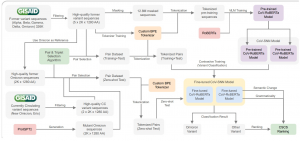
This project is conducted under the leadership of Assoc. Prof. Selma Tekir of Computer Engineering department. This study developed the CoV-SNN, unifying variant classification and escape prediction within an efficient contrastive learning framework. CoV-SNN, built on a Siamese neural network architecture, classifies previously unseen variants by modeling sequence-level similarities and differences through embeddings from CoV-RoBERTa, a lightweight protein language model trained on high-quality SARS-CoV-2 Spike sequences. It prioritizes escape sequences using an enhanced Constrained Semantic Change Search (CSCS) function that maps antigenic variation to semantic change and viral fitness to sequence probability.
Effect of Recombination on the Molecular Evolution of SARS-CoV-2 Genomes
A great attention is put on how individual mutations affect the infectivity and disease dynamics of viruses. However, recombination has the potential to create dangerous viruses. Despite many studies on the mutation-driven variants of Sars-CoV-2, the effect of recombination on the molecular evolution of the viruses is not known. Through a series of projects we compare the molecular evolution of recombinant Sars-CoV-2 variants, and their parent lineage viruses using population genetics and phylogenetic methods. We test the hypothesis that the evolutionary trajectory of the recombinant viruses are different compared to the parent strains that generate them. Therefore, recombinant viruses may generate new dangerous pandemic strains that can evade human immune system and available vaccines and treatments.
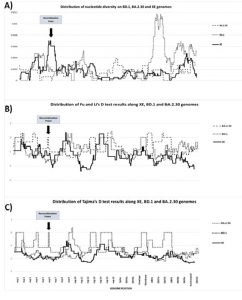
Effect of recombination on sequence diversity and selection on the recombinant Sars-CoV-2 genomes.